East Asia Climate Dialogue 2025 Launches as Regional Cooperation Platform in Key Emissions and Mitigation Testbed

Climate Change Center links the decade of effort that runs through Paris-Belém-Seoul to explore pathways for NDC implementation and cooperation in East Asia.
Dec. 04, 2025 10:00
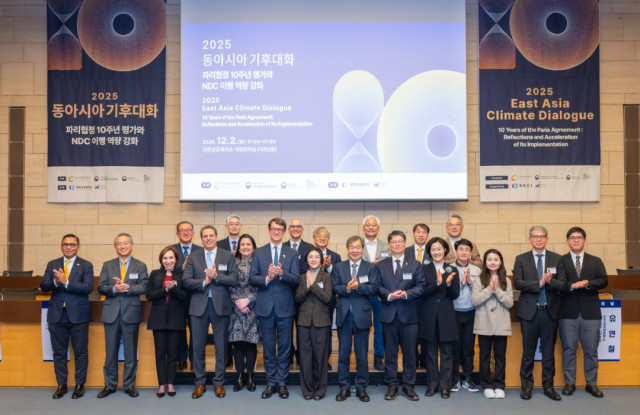
Participants during the East Asia Climate Dialogue 2025 held at the Council Chamber of the Korea Chamber of Commerce and Industry (KCCI) on December 2
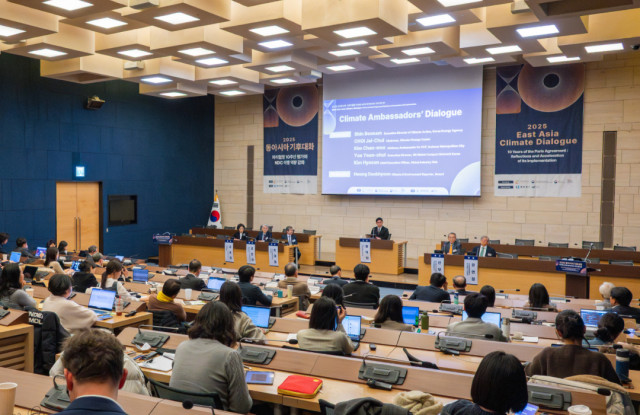
The East Asia Climate Dialogue 2025 is underway at the Council Chamber of the Korea Chamber of Commerce and Industry (KCCI) on December 2
With global greenhouse gas emissions reaching a record high and the Asia-Pacific region accounting for more than half of global energy-related CO₂ emissions, East Asia is drawing attention as both “the center of emissions and the testing ground for mitigation.” In this international context, the Dialogue is highly significant as the first platform where East Asia has officially discussed a joint implementation structure.
At the Opening Ceremony, Chairman Jai-Chul CHOI described the Dialogue as “a turning point in climate leadership from Paris to Belém to Seoul,” and stated that, starting from this “East Asia Climate Dialogue,” there are plans next year to expand it into a broader East Asia-ASEAN cooperation platform that includes the ten ASEAN member states.
Lee Hoe-sung, 6th Chair of the IPCC and Founding Chair of the CFE (Carbon Free Energy), emphasized in his remarks that this Dialogue should both extend the meaning of the Paris Agreement’s 10th anniversary into regional cooperation in East Asia and establish itself as a new implementation platform that connects science, policy, and implementation.
In the subsequent Youth and Citizens’ Dialogue session, social trust and a just transition were presented as core conditions for NDC implementation, and participants agreed on the need to institutionalize youth participation already at the policy design stage.
In the high-level Commemorative and Congratulatory Remarks session, Ban Ki-moon, 8th Secretary-General of the United Nations, stressed in his address marking the 10th anniversary of the Paris Agreement, the importance of “a shift from an era of promises to an era of results.”
Kim Yong-soo, Administrator of the Presidential Commission on 2050 Carbon Neutrality and Green Growth, shared Korea’s 2035 NDC implementation strategy and highlighted the need to build a multi-layered cooperation structure.
Philippe Bertoux, Ambassador of France to the Republic of Korea, and Márcia Donner Abreu, Ambassador of Brazil to the Republic of Korea, each emphasized both the restoration of the Paris spirit and the recovery of multilateralism demonstrated by the Global Mutirão adopted at COP30, and expressed their willingness to strengthen cooperation with Korea and East Asia.
In the subsequent Special Keynote Address, Laurent Fabius, President of COP21 and former Prime Minister of France, emphasized that strengthening the ambition, implementation, and transparency of NDCs is essential to achieving the goals of the Paris Agreement, and assessed cooperation in East Asia as a key pillar of global climate stability.
Former Ambassador for Climate Change, Chung Kee-yong, explained the main agreements reached at COP30 and the significance of the enhanced 2035 NDCs. He also presented a direction under which East Asian countries should organically link carbon markets, climate finance, and mitigation mechanisms.
In the Climate Ambassadors’ Dialogue session, moderated by Hwang Deok-hyeon, Climate and Environment Reporter at News1, five former Ambassadors for Climate Change at the Ministry of Foreign Affairs of the Republic of Korea — Shin Boo-nam (2013-2014), Choi Jai-Chul (2014-2016), Kim Chan-woo (2016-2017), Yoo Yeon-chul (2018-2021), and Kim Hyo-eun (2021-2024) — continued the discussion together.
Having worked on the frontlines of climate diplomacy before and after the Paris Agreement, the panel reflected on the roles Korea has played as a balancer, connector, and rule-maker. They agreed that going forward, diplomacy must both strengthen domestic structural reforms and reinforce international leadership by designing NDCs that are ambitious yet implementable, reinforcing carbon markets and carbon pricing, accelerating industrial and energy transition, and expanding climate cooperation with developing countries.
The final session, NDC Dialogue with Multistakeholders, most clearly demonstrated that this Dialogue served as an East Asian cooperation forum that brought together not only central governments but also a wide range of non-state actors, including industry, regions, and youth.
Participants from Multilateral fund governance, East Asia(Korea, China, Japan), Local governments in hard-to-abate industrial regions, and youth jointly discussed key instruments for implementing the 2035 NDCs, such as climate finance, carbon-market linkages, industrial transition, and regional governance.
In particular, the moderator, Professor Shin Hyun-seok of the Department of Social and Environmental Systems Engineering at Pusan National University (Former President of Busan Development Institute), emphasized that “the center of gravity of implementation must now shift to the younger generation,” and pointed out that to realize East Asia’s mitigation and transition agenda, a structural shift is needed that treats youth not as policy beneficiaries but as strategic partners.
This ‘East Asia Climate Dialogue 2025’ is highly significant as the first stage on which Korea, as a bridge-builder in global governance and climate diplomacy, has officially defined both its own role and shared tasks for implementation in the decade following the Paris Agreement.
The Climate Change Center stated that, building on this Dialogue, it will expand the scope of cooperation to East Asia and ASEAN and gradually establish regional implementation practices and joint cooperation initiatives required in the 2035 NDC era.
About the Climate Change Center
Established in 2008, the Climate Change Center was South Korea‘s first nonprofit public organization dedicated to addressing climate change. As a leading global partner, it has been instrumental in fostering a sustainable and happy low-carbon society. The Climate Change Center unites expertise and wisdom from diverse sectors, actively tackling one of humanity’s most pressing challenges: climate change.
With a robust network that bridges public, private, industrial, and academic sectors, the Climate Change Center focuses on nurturing green leadership, conducting policy research, and fostering collaboration with developing countries. Through these initiatives, it transcends geographical borders and boundaries, collaborating with global citizens to realize a sustainable and prosperous low-carbon future.
Website: https://www.climatechangecenter.kr
Contact
Climate Change Center
Communications Team
Ju-hee Han
+82-2-2038-8019
Send Email
 올인원 PR 플랫폼
기자 검색부터 배포·모니터링까지 한 곳에서 끝내세요
-
2025년 12월 4일 10:00
Related section
