Code of Nature’s Moss-Based Technology Accelerates Soil Restoration at Wildfire-burned Site

Soil organic matter rose nearly ninefold, from 0.21% to 1.85%, within 13 months at a wildfire-burned site, while available phosphate roughly tripled
Nov. 26, 2026 08:56
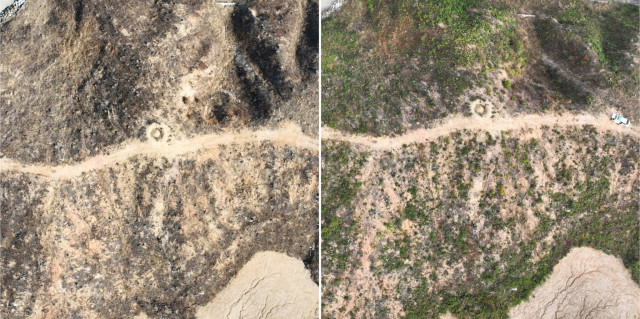
Before (left) and about one year after (right) drone images of a wildfire-burned site in Gyeongpo, Gangneung, South Korea, treated with Code of Nature's moss-based soil restoration solution. (Photo: Code of Nature)
When a wildfire is out, the damage to the ground is not. Intense heat burns away organic matter, kills soil microbes, and compacts the surface, leaving slopes vulnerable to erosion. A 2026 study by Vieira et al. in Nature Geoscience estimated that post-fire erosion accounts for about 19% of the world's annual soil erosion.
Developed using moss spore cultivation technology, the solution combines moss spores with nutrients and beneficial microbes, including Bacillus strains. It is mixed with water on site and sprayed onto exposed soil. The moss forms a living cover that holds the surface and retains moisture, while the microbes restart nutrient cycling.
For wildfire sites, the solution uses Ceratodon purpureus, known as “fire moss” for its ability to colonize burned land quickly. The species occurs worldwide, including across Canada. Beyond burned land, the solution is designed for mines, eroded slopes, reclaimed coastal land and volcanic terrain.
At the Gangneung site, burned in a 2023 wildfire, the solution was sprayed by drone in August 2024. Soil sampled 13 months later showed total nitrogen up from 0.008% to 0.063%, and available phosphate roughly tripled, from 10.65 mg/kg to 33.4 mg/kg. Over the first three months, microbial activity averaged 1.8 times pre-restoration levels. The company is now restoring another wildfire-burned site in Yeongdeok.
About Code of Nature
Founded in 2021, Code of Nature has restored 112.4 hectares of degraded land in South Korea and abroad. It holds 16 registered patents and at least four PCT applications, and its technology is featured in WIPO's Green Technology Book. Learn more at www.c-of-n.com/en.
Website: https://www.c-of-n.com/ko
Contact
Code of Nature
Global Inquiries
Deokyoung Lee
Send Email
 올인원 PR 플랫폼
딱 맞는 기자를 쉽게 찾아 보도자료를 기사로 만드세요
Related section
