Counterfeits account for up to a quarter of unit sales and cause manufacturers to lose up to 28% of profit in Asia

This year, one of the largest South Korean food and feed makers, CJ Foods, is feeling the heat. A spokesperson said this month that it was recalling 42 tons of wheat gluten from China. This is in the aftermath of the global pet food scare, which may have caused as many as 4,000 animal deaths - two Chinese companies were suspected of intentionally mixing melamine, an industrial chemical, in with wheat flour to artificially increase protein readings.
Ironically, South Korea is also a big exporter of fake products. The Korea Customs Office said the illegal export of counterfeit goods rose to US$201 million last year. According to the Japanese Finance Ministry, Asian neighbours China and South Korea were the source of 92.7 percent of all Japanese counterfeit import cases in 2006.
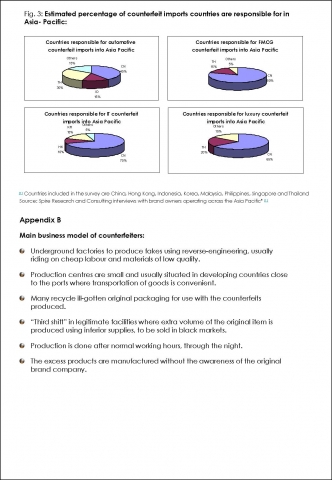
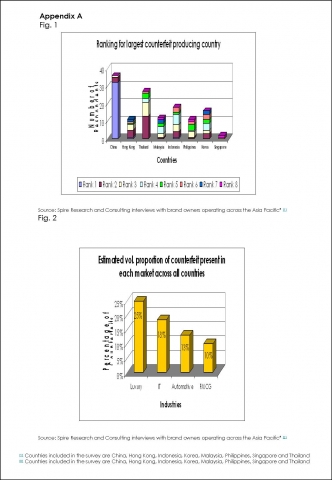
An analysis from the 30 member countries of the Organisation for Economic Co-operation and Development (OECD) shows that close to 60% of all seizures originated in China, Thailand, Hong Kong, South Korea and Malaysia. With other locations such as Indonesia and Philippines capturing an increasing share of the counterfeit production market, the scale and level of counterfeiting have crossed yet more borders (see Appendix A, fig. 1).
Spire Research and Consulting interviewed nearly 40 global companies operating in Asia on the increasing sophistication of counterfeit production over the last half decade.
The resulting insights include:
Counterfeits are present in almost every range of material goods. In fact at least 10% of volume sales are estimated to be counterfeits within the following product categories, with luxury goods currently still leading with 25% (see Appendix A, fig. 2):
Automotive (counterfeit level 13%) - oil and air filters, general body parts (such as head lamps and bulbs), car suspensions, steering wheel and brake pads are most often counterfeited.
Around US$200 million is lost in sales of auto parts by South Korean Hyundai due to counterfeit parts made in China .
Fast moving consumer goods or FMCG (counterfeit level 10%) - sports brand clothing and accessories (including bags and shoes), medication/drugs, shampoo and skin-care products are key counterfeit targets.
Last year, Adidas seized more than four million fake Adidas products, according to a spokesperson for the sports brand company.
IT (counterfeit level 18%) - software programs e.g. Windows and Microsoft Office, ink and toner cartridges, computer hardware, music players and mobile phone technologies.
Samsung Electronics recently released a report that claims Chinese counterfeits account for 12 percent of the sales volume of its Anycall mobile phones in the Chinese market, or 6.5 million units, causing around US$1.1 billion of losses for the firm .
Luxury (counterfeit level 25%) - leather products (e.g. bags, belts and key chains), watches and clothes are heavily counterfeited. Even though China dominates the fake luxury goods market in Asia, South Korea and Hong Kong are reputed to produce higher-quality counterfeits.
Interestingly, the traditional Korean dexterity in handicraft production has helped counterfeiters produce or copy luxury items efficiently. According to one observer, "market vendors throughout Asia seem to agree that the best fake handbags are manufactured in South Korea."
The estimated average profit lost to counterfeits for each category across the countries is as follows:
------------------------------------------------------------
Automotive/FMCG/IT /Luxury
------------------------------------------------------------
(Profit lost to counterfeits )28% /13% /24% /22%
------------------------------------------------------------
Advancements in technology are the main factor that has improved the quality of counterfeits in the luxury and automotive parts industries:
It has become easier to consistently produce goods like apparels and accessories of a higher quality.
Original designs can be effortlessly and more cheaply copied with the use of advances in scanning, printing, 3-D modeling, and other tools of reverse-engineering (please see Appendix B).
Technology has also contributed to the significant shortening of lag time between the original product launch and the availability of the counterfeit products.
The business strategy of counterfeiters is evolving to become more efficient to avoid detection, with about 25% working from home operations to carry out manufacturing, mail orders and product distribution.
Statistics provided by Korea’s Customs Service show a steep increase in online counterfeiting activities. These totaled 4 percent of all counterfeiting activities in 2002 but by 2005, that figure had risen to 67 percent .
Korea's Customs Service and KIPO, along with numerous Korean e-commerce sites and the European Chamber of Commerce, have been working with a number of famous brand owners to cut down on the proliferation of manufacturing, marketing and exporting of counterfeit goods. So far, estimates indicate over US$90 million worth of counterfeit goods were seized between February and April last year , a three times increase from the goods confiscated in the whole of 2005.
About Spire Research and Consulting
Spire Research and Consulting is Asia's leading strategic market intelligence consultancy. Spire's competitive advantage lies in its ability to deliver to its clients actionable intelligence on the external business environment in support of their strategic decision-making in marketing and business development. Spire is one of the few companies in its industry to be headquartered in Asia. Spire's clients include over 20 Fortune 500 organizations as well as Government agencies in nine countries. For more information, visit us at www.spireresearch.com.
Spire Research and Consulting 개요
스파이어리서친앤드컨설팅 (Spire Research & Consulting) 사는 아시아 지역의 시장조사 및 컨설팅을 하는 회사로서 싱가폴에 본사가 있으며 한국, 중국, 홍콩, 말레이시아, 베트남, 인도네시아에 가 지사를 두고 있습니다. 시장규모, 향후 전망, 진입장벽, 경쟁업체분석, 유통망분석, 가격조사 등 모든 제품과 서비스의 새로운 시장진입에 대한 조사 및 컨설팅을 하는 회사 입니다.
웹사이트: http://www.spireresearch.com
연락처
Spire Research and Consulting Dr Justin Lee 82+31+ 908 +7630 이메일 보내기
 올인원 PR 플랫폼
기자 검색부터 배포·모니터링까지 한 곳에서 끝내세요
-
2008년 5월 21일 09:54
관련 분야
