Deputy Prime Minister, Oh's Address at the International Ministerial Conference of Nuclear Power for the 21st Century
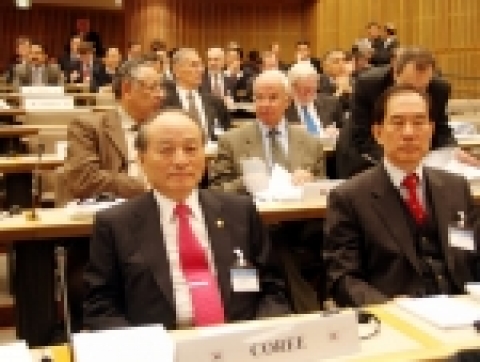
Deputy Prime Minister Oh at the International Ministerial Conference of Nuclear Power for the 21st Century.
YourExcellencies,
Conference President, Mr. Patrick Devedjian, Director General of the IAEA, Mr. Mohamed ElBaradei, and the Secretary General of OECD, Mr. Donald Johnston,Distinguished delegates, Ladies and gentlemen.
On behalf of the Government of the Republic of Korea, I would like to extend our warm congratulations to Mr. Patrick Devedjian on his appointment as the President of the International Ministerial Conference of Nuclear Power for the 21st Century.
It's a great honor for me to have this opportunity to present Korea's initiative on Nuclear Power in the 21st Century.
It cannot be denied that the peaceful use of nuclear energy has contributed greatly to a sustainable and stable supply of energy over the last fifty years. It has also contributed to considerable economic developments and an enhanced level of human welfare around the globe.
However, many challenges are still lying ahead for the international nuclear society in the 21st Century.
In this regard, I believe this conference bears a great significance, which provides forum for discussions among the world leaders in the field of nuclear energy.
I'm sure that this conference will provide a great opportunity to derive solutionsand answers about the global energy challenges of the 21st Century.
Now, let me take this moment in time to convey to the conference, how Korea has dealt with some of these issues, and how we intend to address the future challenges to a global nuclear energy supply.
II. Present and Future of the Korean Energy
Over the last two decades, the energy and electrical consumption in Korea has increased more than five-fold and seven-fold, respectively.
It has brought outKorea as one of the top ten energy consuming economies. Furthermore, it is expected that the consumption of energy and electricity willcontinue to riseby 50% and by 2020, respectively.
It is also anticipated to increase additional 50% by the 2020's. Due to its lack of energy resources, this will place an enormous burden on the Korean economy, with its overseas energy dependency reaching 97%.
Given these scarce indigenous energy resources in Korea, we believe firmly that the application of nuclear energy is inevitable for our future economic development.
Since the construction of our first nuclear power plant in 1978, a total of 19 power plants including seven 1,000 MWe Korea Standardized Nuclear Power Plants are currently in operation. It generates 40% of the national electricity demand.
Nuclear power generation will gain more importance in Korea, with additional 8 new nuclear power plants under way including two 1,400 MWe nuclear power plants so-called APR-1400, to be constructed by year 2015.
Based on the aforementioned expansion of nuclear energy in Korea, we are of the opinion, that future policy direction for development of nuclear energy will be centered around such issues as :
- enhancement of nuclear safety
- the safe management of nuclear wastes- the nuclear non-proliferation; - the competitiveness of nuclear power in the energy market - and international cooperation toward nuclear technology innovation for wider use of nuclear energy.
We can assure you that nuclear safety and safe management of nuclear waste are pre-requisite for the use of nuclear energy in Korea, andthey mark the highest priority during the implementation of Korea's national nuclear program.
In particular, a social consensus is an essential element during the national policy making process in Korea,so that the national policy reflects the public concerns for safe operation ofthe nuclear power plants and for safe management of nuclear wastes
To deal with these challenges, we believe that more emphasis should be placed on public acceptance and confidence building than ever before. Ultimately it is for gaining full support from the general public.
Korea appreciates the international nuclear society's efforts in strengthening the nonproliferation regime. There have been various measures including reinforcement of an export control and the IAEA safeguard measures.
In order to enforce the international mandates and toimplement the international NPT regime faithfully, Korea is constructing a legal and social framework, that coincides with the international standards fornuclear non-proliferation such as amendments of the Korean Atomic Energy Act, implementation of the IAEA additional protocol and so forth.
We believe that these active measures are essential elements for ensuring national transparency and confidence within the international society.
We have concluded that we should strengthen the competitiveness in the nuclear energy industry markets. In particular, greater emphasis should be placed on the technological and economical innovations as well as environmental friendliness of nuclear energy.
Recently we expanded our Nuclear Research and Development activities for the innovation of nuclear technologies and enhanced international cooperation by joining the international nuclear co-operation projects, such as GIF (Generation IV International Forum) and the IAEA's INPRO.
Specifically, in an effortto build a basis fora hydrogen energy economy in the near future, Korea has recently launched national R&Ds to develop VHTR (very high temperature reactor), which can produce high temperature for hydrogen production by nuclear power.
Ladies and gentlemen,
As you are already aware of, the Kyoto protocol entered into force with ratification of 141 countries as of February 16, 2005. It requires world economies to reduce greenhouse gas emissions, which have increased twice since the 1990's.
I am confident that nuclear energy will contribute in preventing global warming, resolving world energy problems, promoting human welfare, and progressing the world economy.
I believe another nuclear renaissance will take place in the future. For this, the global community should assign a larger role to the nuclear energy such as space heating, hydrogen production, vehicle propulsion and sea water desalination, and expand the application of radio-isotopes to various industries.
While bearing all the aforementioned in mind, we are of the strong opinion that coordinated international efforts are crucial for strengthening the international regimes of nuclear security and nonproliferation. I am confident that such efforts will ultimately make a contribution to the world peace and security.
At the same time, we believe thatinternational cooperation is essential to ensurethe highest standards of nuclear safety and the safe management of the radioactive wastes for a continuous use of nuclear energy.
III. Closing Remarks
It has been more than 50 years since nuclear energy was first introduced to the world.
However, the international nuclear community is facing many issues that need to beresolved through joint international efforts.
I would like to confirm that the peaceful uses of nuclear energy are inevitable and indispensable options for reduction of greenhouse gas emission and the future welfare of our respective nations.
Finally, Korea reaffirms its commitment to the international nuclear community, and promises to make contributions in resolving complex issues that are facing us in the decades to come.
Thank you very much.

